
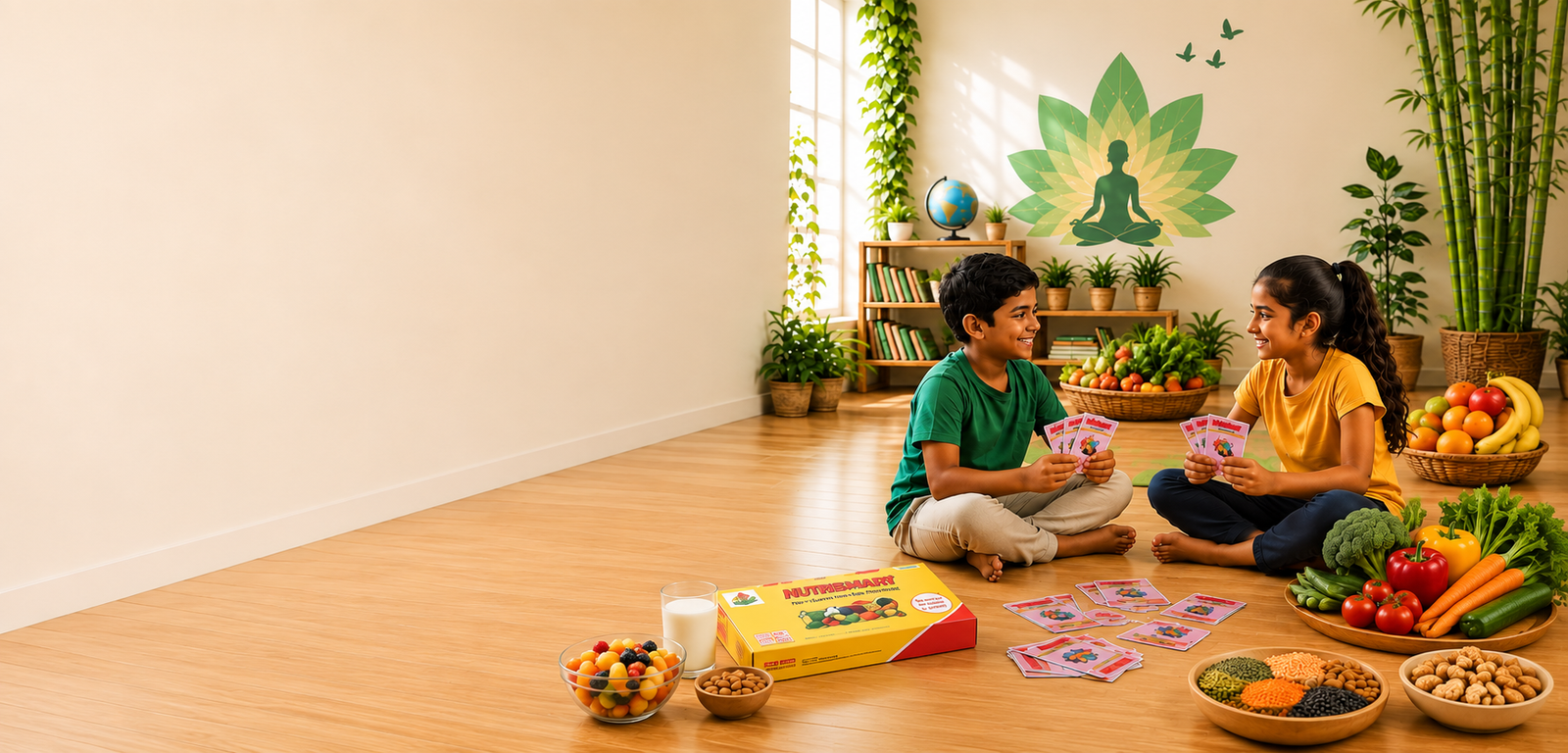
Ask any adult what's richest in calcium. Almost all get it wrong.
96% default to milk. Few know that sesame seeds contain 10× more calcium. If adults don't know, children have no chance — unless someone actually teaches them.
The Nutrition Programme takes children on a continuous journey: BeSmart builds instinct, Nutrition Smart builds science.
Trusted by schools and CSR partners including Tata Coffee, EY, IBM, Oracle, BNP Paribas, Dr. Reddy's and Cytiva.
Children who understand food make better choices.
In India, 61% of deaths are linked to non-communicable diseases like diabetes and cancer — driven largely by poor nutrition literacy, not lack of food. Childhood obesity now affects 14.4 million children in India, the second highest of any country. Yet most children — and most adults — were never actually taught the basics.
Start with instinct. Build the science.
Most nutrition programmes try to teach children too much too soon. InspireMinds takes a different approach — two games, two age groups, two stages of nutritional understanding that build on each other.
BeSmart
Before children are ready for nutrient-level detail, they need the basic instinct — healthy or junk, good habit or bad. BeSmart builds that instinct through colourful board game play. It's the foundation that makes everything that follows possible.
Nutrition Smart
Once the instinct is established, Nutrition Smart goes deeper — into the actual nutritional science behind everyday Indian foods. Four gameplay modes. 15 core nutrients. 40+ foods. Children learn things that surprise even their parents.
The starting point — healthy or junk?
BeSmart uses two board games to build the most fundamental nutrition skill a young child can have — the ability to tell healthy from unhealthy, and good habits from bad, without thinking twice.
- Sorting foods into healthy and unhealthy categories through gameplay
- Identifying good and bad daily habits
- Early recognition of real Indian foods and their role in a healthy diet
- The confidence to make simple food choices with awareness
Four gameplay modes. Four layers of knowledge.
Nutrition Smart is not one fixed game. It's designed to be played four different ways — each building a different layer of nutritional understanding, based on National Institute of Nutrition data.
- Nutrition Max — discover which everyday Indian foods are richest in key nutrients.
- Nutrition Trump — compete by comparing nutrient values and build confidence through play.
- Nutrition Set — understand balanced diets and the role of different food groups.
- Nutrition Donkey — tackle the trickiest nutrient comparisons and make learning memorable.
Every session — whether BeSmart or Nutrition Smart — follows the same four-part arc.
Story
BeSmart's characters and Nutrition Smart's food cards anchor each concept in something concrete and memorable — not abstract facts.
Experience
Gameplay brings each concept to life — sorting, comparing, choosing — not memorising.
Reflection
Children start noticing their own food choices at home, connecting what they've learned to daily life.
Habit
Repeated play across the 4–20 hour syllabus turns awareness into a lasting instinct.
A sample student journey
A child who previously reached for packaged snacks starts playing Nutrition Smart in class. Over the syllabus they learn which foods are actually rich in calcium and iron — and start recognising traditional Indian foods they had overlooked before. At home they start asking questions about what's in their food. Soon parents notice the child pointing out healthier snack options unprompted. The goal is not perfection. The goal is awareness. Because awareness is the first step toward lasting change.
What your school receives
BeSmart
- 2 board games — healthy vs. junk food · good vs. bad habits
- Colourful food and habits book
- Laser-cut UV-coloured vegetable and fruit pawns
Nutrition Smart
- 3 card packs — 45 cards each
- 48-page Nutrition Sudoku puzzle book
Additional materials
- Multidisciplinary worksheets — nutrition and math combined
- 4 to 20 hour structured school syllabus
- Ready-to-run classroom sessions — no teacher training required
Two ways to bring the programme to your school
Self-Guided
Teachers run BeSmart and Nutrition Smart using the provided syllabus and materials. No facilitator required. Ideal for a low-effort introduction to the programme.
InspireMinds-Facilitated
We run classroom sessions directly with your students using the full syllabus. Ideal for schools wanting a guided, in-person experience.
In a structured nutrition-awareness pilot.
Nutritionist Review
The expert validates the science
Teacher Review
The educator validates the classroom experience
CSR Volunteer Review
The facilitator validates real-world delivery
"The children were so engaged they did not realise they were learning. By the end they were correcting each other's food choices — and laughing while doing it."
Your children already have access to food.
Give them the knowledge to choose it wisely — the nutrition awareness and healthy habits they need to thrive, in school and far beyond it.